
The City of Fountains
For some reason, I have never paid much attention to the humble water fountain. Even those grandiose manifestations of Victorian aquatic architecture, such a trademark of just about every English public park when I was growing up had never really caught my eye. However, in the stupefying heat of a Provençal summer, the functions and presence of fountains were suddenly thrust into the focus of my attention.
Seemingly at every major junction and/or roundabout in Aix-en-Provence there is a physical water feature of some kind. Some are hardly accessible at all due to the volume of traffic, while others burble quietly to themselves amongst almost empty or largely pedestrianised backstreets. Visitors and tourists alike sit around them, when they can, appreciating their impact on moderating the air temperature. In one, a solitary Mediterranean sparrow takes a hasty bath, while at another a flock of parakeets skitter noisily.
So, what's all this got to do with dowsing? Quite a lot, in fact.
Logic implies that most public fountains in the pre-modern era probably started out as useful, functional, life sustaining springs, which were later converted into municipal sources of potable water. Many of the fountains we encountered in Aix did indeed have crossing water lines of one kind or another in their vicinity, implying that they had originally been appropriate sites for shallow wells or emergent surface water flows.
However, the location of these features amid any city with well defined crossroads embedded into an essentially gridiron street plan implies that there is rather more to this conflation than meets the eye. The plot thickens when we take a closer look at the other energies that run through the fountains. Earth energy grids, especially Hartmann and Benker feature strongly and regularly. Energy leys and straight lines of consciousness are almost ubiquitous. Celestial grid lines make many an appearance.
It would seem that the placement of fountains through history has been the subject of an intense interaction between the geology, the hydrology, the needs of humans and the spirit of place, all of which are eminently dowsable.
Aix is known as The City of a Thousand Fountains. In fact this is something of a Gallic exaggeration, as the actual number is about 107 (or 30, depending which website you look at!). However, given that our much larger Plymouth only has two or three that I can think of, and rain drenched Tavistock none at all, it is a quite remarkable statistic.
Dowsing the fountain simply as a water station, the quality of the available supply was almost always in the drinkable range of the spectrum, with some in the very pure categories. On a couple of occasions we even filled our own water bottles at a public tap (after dowsing, I hasten to add) and lived to tell the tale. It's something I wouldn't even consider in the UK.
Every major fountain we encountered had either a ley or a celestial grid line running right through it, sometimes with multiples of these and there are also examples where they appear at crossing points of various energy flows.
Given that leys and grids are essentially static universal features, how does this account for the presence of water at these locations?
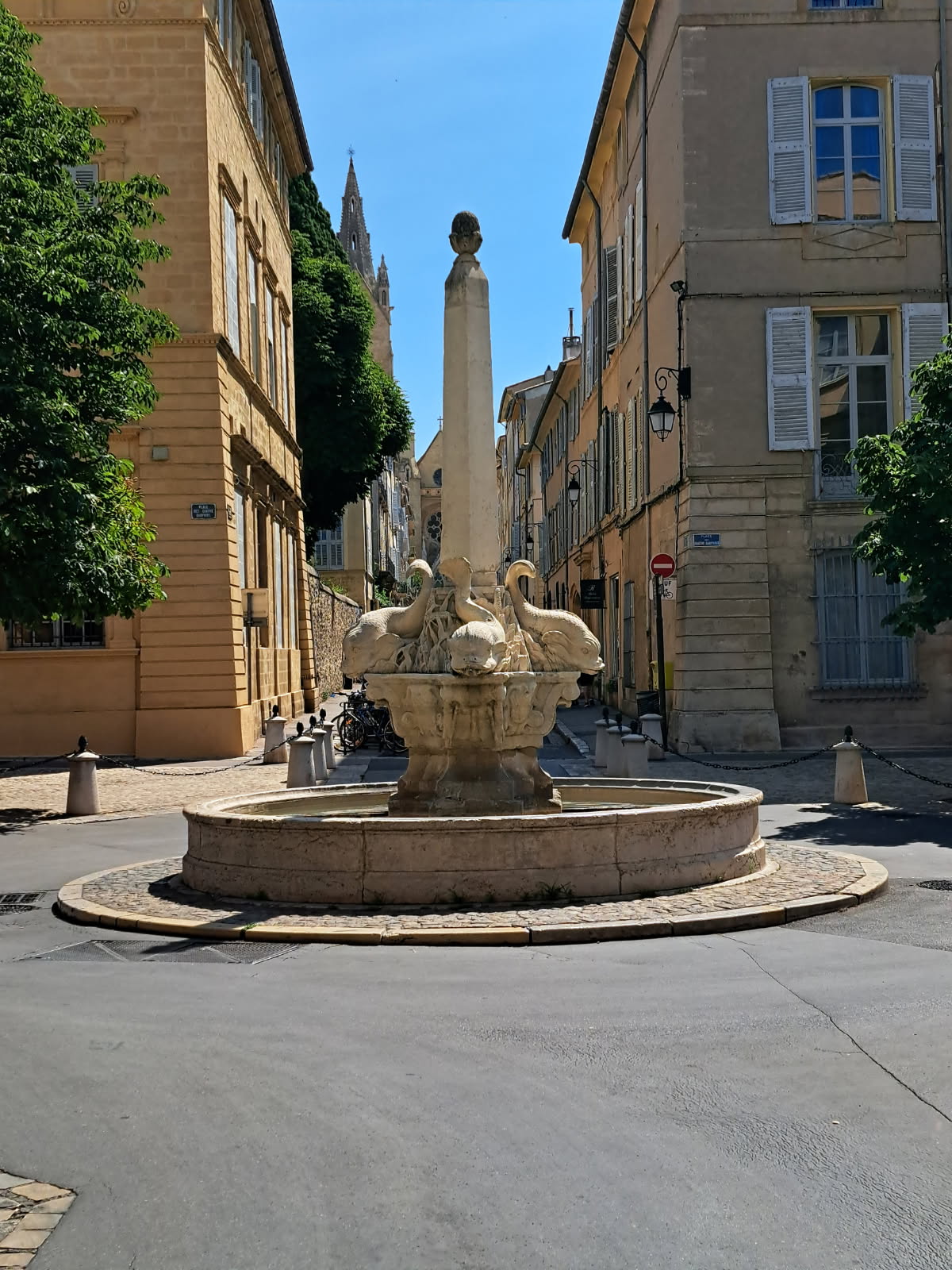
Take a classic example, the Fontaine des Quatre Dauphins (four dolphins) - see picture to the right.
Here a bold, wide ley runs straight up the Rue Cardinale, through the fountain to the church of St Jean de Malta. Lunar grid lines cross at the centre of the feature. There are various earth energy and water lines around, yet it doesn't feel or dowse as the super sacred spot you might expect. My view is that the water has been brought to the centre, rather than it naturally crossing in the centre.
It is such a fascinating mesh of dowsable energies and I would be pleased if others could verify or contradict this personal observation.
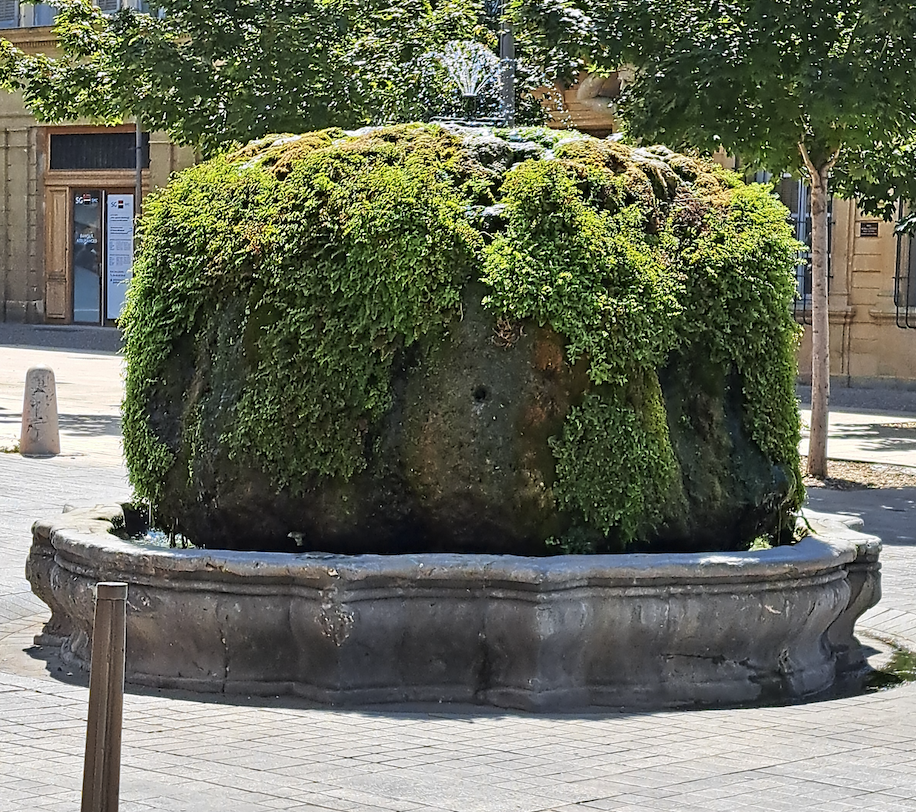
Another interesting fountain is the Fontaine Mousse in the Cours Mirabeau (the main shopping boulevard). This feature actually has warm, well tepid water.
The vegetation is mossily luxuriant in a way you wouldn't usually expect in (say) Plymouth's Royal Parade, probably due to the rich mineralisation of the source.
Aix has been a spa town (its twinned with the city of Bath) since at least Roman times. You can still bathe in the official spa water, at a price. Earth energy currents and other numerous other grid lines abound in this busy thoroughfare, but again it dowses as being a really lively place, rather than as a conventionally sacred site, such as in the local Cathédrale de Saint Sauveur.
The warmth of this water implies that the outflow at Fontaine Mousse is the result of natural geology, but my own dowsing was equivocal. It seems that the inherently warm water veins appear at the surface where the geology permits, but over the years at least some of these springs have been 'encouraged' to surface in places more useful or more significant to the local population.
One can only deduce that while the established availability of potable, health-giving water was the reason for this city (and, by inference, cities across the world) being founded where they can still be found today, both town planners and mystic seers across the ages have sought to synchronise the precious nectar with the geological, cosmic and humanly generated energies to produce the both the physically practical but also the energetically uplifting siting of the fountains that we visited.
It is something that I feel the need to examine in the cooler reality of the workaday UK. Seemingly from nowhere, and after decades of practical rod-waving, it has given me a whole new field of research to further my interest in our craft.
Being both a dowser and a former town planner, I am fascinated by that thought, and it made it more than worth our while braving the oppressive heat to find it for myself, aided maybe just a little, by the friendly reception and the proliferation of local organic red wine.
Nigel Twinn, July 2025.
Images - Ros Twinn